Neighbor Complained About Your Dog? Go Ask, Not Apologize
They know things you do not, because you are out when it happens. Four questions that turn an awkward doorstep conversation into the data you need.
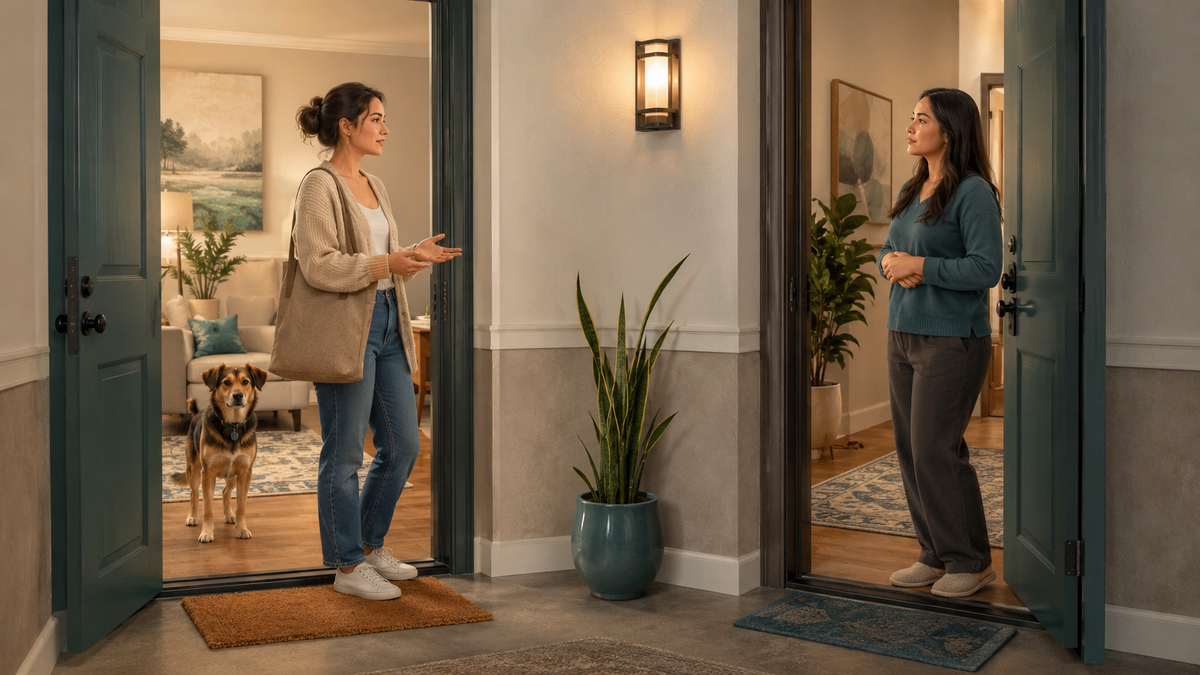
Go early, and go to ask rather than to apologize. Your neighbor has information you do not: you are almost certainly out of the apartment when the barking happens, and they are not. Four questions, asked without defensiveness, will tell you whether you have a trigger problem or an absence problem, which determines every decision you make afterward. The apology matters too, and it is the smaller half of the conversation. Advice across the pet and rental press agrees on the tone: acknowledge the frustration, do not get defensive, and treat it as a shared problem.
Why they know things you do not
This is the part most people miss while they are dreading the conversation.
The barking that generates complaints in apartments is overwhelmingly the barking that happens when the owner is out. That means the person who has heard your dog most is not you. They know what time it starts, roughly how long it goes on, whether it is daily, and often what set it off, because they were sitting there when the elevator arrived or the delivery came.
You cannot buy that information. A monitor gets you part of it, and a neighbor gives you the rest for free, including the part a monitor cannot capture: what it sounds like through the wall from their side.
So the conversation has a purpose beyond keeping the peace. It is the cheapest and fastest diagnostic available in this whole cluster.
What to ask, and what the answers tell you
| Ask | If they say | It probably means | Do this next |
|---|---|---|---|
| "When is it worst?" | "Right after you leave, then it stops" | A departure-linked pattern | Treat this as a professional question, not a hardware one |
| "All day, on and off" | Continuous, absence-related | Same, and start a log today | |
| "When the hallway is busy" | Sound triggers | Seal the door, consider masking | |
| "Evenings, when people walk past outside" | Visual triggers | Block the sightline | |
| "How long does it usually go on?" | Minutes | A trigger pattern | Environmental fixes are likely to work |
| Hours | Not a noise problem at heart | See a veterinarian | |
| "Is it every day?" | Yes | Established pattern | Log it, act now |
| Only some days | Something varies, often your schedule | Compare against your own diary | |
| "Which room do you hear it in?" | Bedroom, through the wall | Airborne through the shared wall | Mass and sealing |
| "It comes from the hallway" | Escaping through your front door | Door sweep and weatherstripping first |
That last question is the one nobody asks and it is worth more than the rest combined, because it tells you the path the sound is taking. Why that changes the fix entirely is in airborne vs impact noise for apartment pets, and which fix matches which path is in renter-safe soundproofing that comes off at move-out.
What not to say
Do not admit a lease breach. Acknowledge the experience, not the violation. "That sounds frustrating, especially if it is waking you" is warm and concedes nothing. "I know he barks excessively" is a sentence that can end up in a building complaint.
Do not promise it will stop. You cannot guarantee an animal's behavior. Promise what you control: that you will find out what is happening and take steps.
Do not argue about whether it is really your dog. Even if you suspect it is not, that conversation goes nowhere at the doorstep. "Let me find out what is actually happening" gets you the same place without the confrontation.
Do not offer money or make it transactional. It changes the relationship into a negotiation and sets a precedent.
The follow-up a week later
This is the highest-value and least-used move in the whole exchange.
Go back after a week. Say what you did, with the date. Ask whether it is any better. That is it.
Three things happen. You get a second round of data, which tells you whether the fix worked from the only perspective that matters. The neighbor sees a person who followed through, which changes how they behave if it continues. And if this ever becomes formal, you have a documented record of a resident who investigated, acted, and checked, which is close to exactly what a cure period asks for. What that looks like on paper is in documenting a noise complaint when it's your pet.
When to skip the doorstep and use the building instead
The direct approach is right most of the time and not always.
Skip it if there is any history of hostility or if you have any safety concern at all. Skip it if the building's rules require complaints and responses to route through management, since going around that can itself be a problem. And skip it if the complaint already arrived as a formal notice, because at that point you are responding to the landlord, not opening a neighborly conversation, and the reply belongs in writing.
If the relationship is already difficult, a brief, polite written note through management is a reasonable substitute, and it preserves the record.
FAQ
Should I talk to my neighbor before my landlord gets involved? Usually yes. Most people prefer being asked to being escalated to, and the conversation gets you information about when and for how long that you have no other way to obtain. The exceptions are a history of hostility, a safety concern, or building rules that route everything through management.
What if I do not know whether my dog is actually barking? Say so. "I am out when it happens, so I am setting up monitoring this week to find out" is an honest and strong answer, and it turns the conversation into a joint investigation. How to capture it is in knowing your dog barks while you're out.
Should I apologize even if I think they are exaggerating? Acknowledge their experience without conceding the facts. You genuinely do not know yet, and the tone you set now determines whether this stays a conversation or becomes a file with the building.
What if the conversation goes badly? End it politely and move to the written and physical track: log what happens, make one dated fix, and let the record do the work. A neighbor who will not engage is a reason to be more organized, not less.
Do I have to tell them what I am doing about it? You do not have to, and it helps. Naming one dated, concrete change is what separates a resident who is handling it from one who is hoping it goes away, and it is what they will report back if the building ever asks them.