Is Your Pet Feeder Waking the Neighbors? Probably the Bowl
The motor is not what carries. Kibble hitting a steel bowl is an impact, which is why the unit below hears your feeder and the one beside you does not.
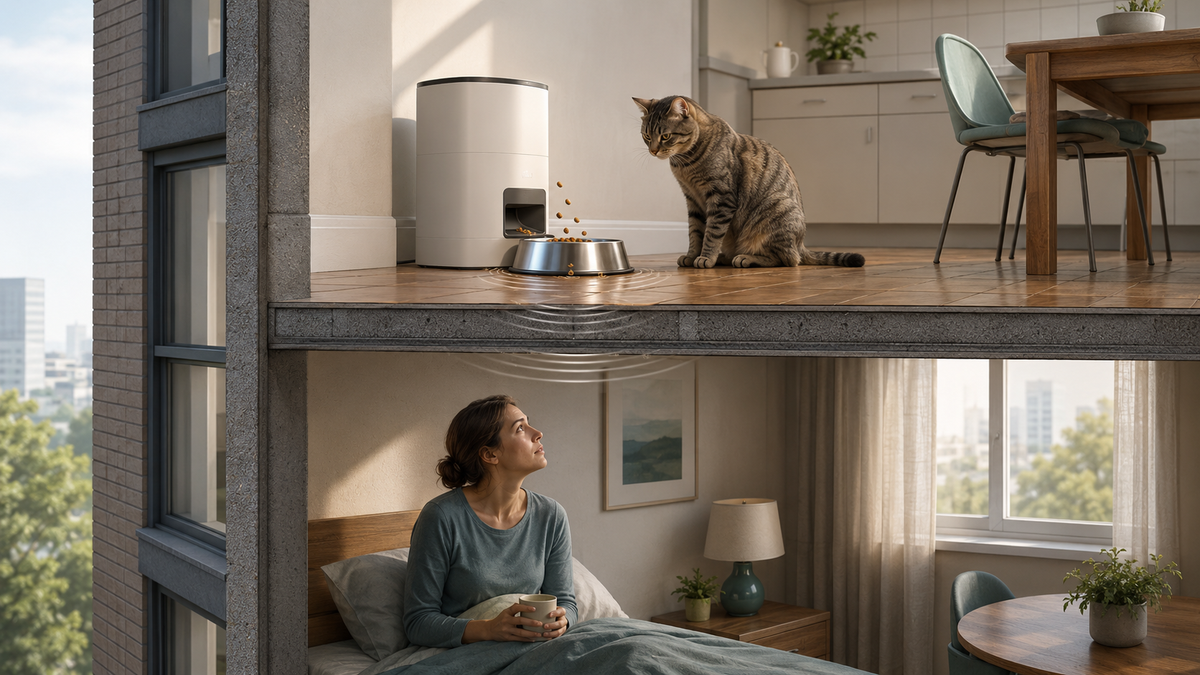
If a pet device is generating complaints, the noise almost certainly is not the motor. Owners consistently report that the dispensing mechanism is quiet and the sound of kibble striking a steel bowl is what carries, and that is a different kind of noise entirely: a series of small impacts into a hard surface resting on the floor. Impact noise travels through the building structure to the unit below, which is why a downstairs neighbor can hear a feeder that is inaudible to the person on the other side of your bedroom wall. The three fixes that follow cost nothing: a mat under the bowl, a different cycle time, and a different wall.
Is the constraint the machine, or is it the flat?
That question is the boundary of this page, and it is worth stating so you know what you are reading.
How these devices work, how reliable they are, what capacity to choose and which model suits your animal is the machine question, and it is not covered here. This page covers only what happens to the noise once the device makes it: whether it crosses into another unit, and what you can do about that without changing the device at all.
If the device is waking you, that is a placement and product question. If it is waking your neighbor, that is this page.
Why the food is louder than the motor, and where that noise goes
A dispensing cycle produces two distinct sounds.
The mechanism is airborne: a motor, an auger, a flap. Owners describe it as generally quiet, and airborne sound at that level struggles to get through a wall in any meaningful quantity.
The food landing is an impact: dozens of hard pellets striking a metal or ceramic bowl, which then transmits that energy into whatever it is standing on, which is usually the floor. That is a percussive event with a broad frequency content and a direct path into the structure.
This is exactly the split covered in airborne vs impact noise for apartment pets, applied to a machine instead of an animal. It explains a pattern that otherwise looks random: the neighbor beside you never mentions the feeder and the one below you asks what happens at six every morning.
The same logic sorts the other devices. A fountain pump is airborne and low-level, so it matters mainly if the device sits against a shared bedroom wall. A litter box's cleaning cycle is both: a motor hum that is airborne and a mechanical clunk that goes into the floor.
What the published numbers are worth
Very little, and it is worth being precise about why.
There is no independent, comparable decibel testing of these devices that is publicly available. The closest thing is a retailer's own comparison chart for self-cleaning litter boxes, reporting a range of roughly 32 to 65 dB across the products it lists. That is a commercial source publishing numbers about products it sells, using a method it does not fully describe, and it is not equivalent to independent testing.
Two reasons a spec number would not settle your question even if it were reliable. It measures the wrong sound, since the figure describes the device, not the food hitting the bowl or the bowl coupling to the floor. And it measures at the wrong place, next to the machine rather than in the room below. A device could be quiet by both the manufacturer's number and your own ears and still be the loudest thing in your neighbor's ceiling at 6 a.m.
So do not choose on a decibel claim, and do not defend yourself with one either. The reasons phone measurements will not help you here are in phone decibel apps and what they're actually worth.
Three changes that cost nothing
Put something dense under the bowl. This is the single highest-value change, and it is the folk fix that owners arrive at independently: a plate, a mat, a rubber pad. It works for the same reason a rug pad works, absorbing the impact at the point of contact before it reaches the floor. Denser and thicker performs better than thin and soft, and the same reasoning is set out in rugs and underlay for pet impact noise.
Move the cycle out of their night. These devices run on a schedule you chose. A feed at 6 a.m. is a decision, not a constraint, and shifting it an hour or two removes the complaint entirely in many cases without touching the hardware. Where the animal's routine allows it, this is free.
Check which wall it is against. In most apartments some walls are shared and some are internal. A device on a shared wall, especially one backing a bedroom, is working against you. Which surfaces are available and how to rank them is in where not to put a pet device in a one-bedroom.
The device that is loudest is the one that fails
A note that belongs on every automation page on this site.
The noise a device makes when working is a nuisance. The noise it makes when it fails is a different category: a jam alarm, a repeated error beep, or a cycle retrying over and over. Manufacturer support documentation for automatic feeders includes guidance on continuous error beeping, which tells you it happens often enough to document.
So the failure plan matters for the neighbor as well as the animal. Two questions worth answering before you leave for a weekend: would you know if it failed, and what happens to the animal if it did. A device that alarms continuously into a shared wall while nobody is home is the worst version of this problem, and an unfed animal is the more serious half of it.
For the wider picture of how a device fits an apartment at all, see which pet devices actually earn apartment space and power and the cluster overview in pet noise in an apartment: what neighbors actually hear.
FAQ
Are automatic pet feeders loud enough to disturb neighbors? The mechanism generally is not, and the food hitting the bowl can be, because that is an impact that transmits into the floor and reaches the unit below. Owners in forums consistently describe the bowl rather than the motor as the noisy part.
Which neighbor is most likely to hear my pet device? The one below, for anything involving something striking a hard surface on the floor. A neighbor through a shared wall is more likely to hear a continuous airborne sound such as a pump hum, particularly if the device sits against that wall.
What is the quickest fix? A dense mat under the bowl, then moving the scheduled cycle out of the neighbor's sleeping hours. Both are free or nearly free and neither requires changing the device.
Do quiet-motor claims on the box mean anything? Not for this problem. They describe the mechanism rather than the food landing or the coupling to the floor, and there is no independent comparable testing of these devices publicly available to check them against.
What about a litter box's cleaning cycle at night? It produces both airborne hum and a mechanical impact, so it can reach both neighbors. Timing is the lever again, since the cycle is usually configurable, and the surface it stands on is worth treating the same way as a feeder bowl.