
Is an Apartment Unfair to a Dog? What the AVMA Says
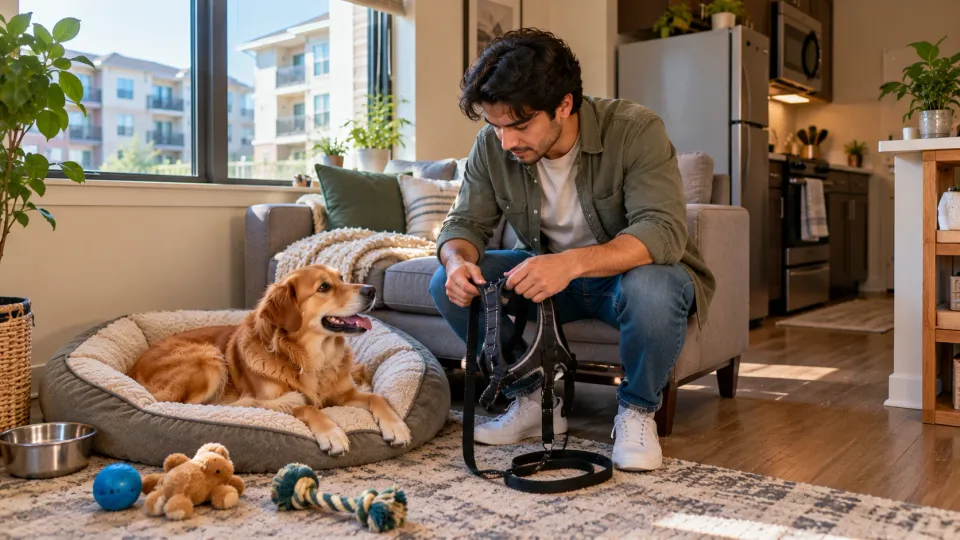
The question most apartment dog owners are really asking is whether the lack of a yard is unfair. The most useful answer comes from the American Veterinary Medical Association, whose background document to its model bill on the care of dogs states that stringent technical requirements for a specific exercise area, or fixed time allotments for activity, are not recommended, because a dog's needs are complex and variable and depend on age, breed, reproductive status and housing environment. It also notes that an acceptable activity programme may consist of leash walking.
Read that carefully, because it reframes everything. A named veterinary authority is saying that space-based rules do not reliably serve a dog's welfare. So the question is not how many square metres you have. It is whether your routine works, and a routine is something a renter can actually build.
This article is about the apartment, not about your dog's health. Nothing here is veterinary advice, and questions about whether a particular dog is doing well belong with a veterinarian who can examine the animal.
What the AVMA actually says about space and exercise
Worth being precise, because this is the load-bearing citation.
The AVMA's position, in its background to model legislation on dogs kept as pets, is that specifying an exercise area or an amount of locomotory time does not deliver a tangible welfare benefit, because those needs vary with the individual animal and its circumstances. It notes that dogs housed with compatible companions have less need for additional activity than dogs kept in isolation, and that leash walking can form part of an acceptable programme.
Two things follow for an apartment dweller.
A yard is not the standard against which you are failing. It is one way of delivering activity, and not automatically a good one, since a dog alone in a yard may do very little.
Isolation is a bigger variable than floor area. That is the honest concern in an apartment, and it is not about the square metres.
The four things an apartment genuinely changes
Not health factors. Logistics, and they are the actual difference between a house and a flat.
No yard, so every elimination is a trip. There is no letting the dog out for two minutes. Every single occasion is a full outing that you have to be present for.
An elevator, so every trip has latency. The gap between the dog needing to go and being able to go is measured in minutes, not seconds, and it is longer at peak times and worse when the lift is out.
One room, so there is no separating anything. No spare room to close a door on, no separating the dog from a visitor, a delivery, a vacuum or a bad day.
A shared wall, so ordinary dog behaviour becomes a neighbour's problem. In a house, barking is a private matter. In a flat, it is a lease matter.
Every one of these is solvable, and none of them is what the veterinary SERP is talking about when it discusses dogs and apartments.
Elimination without a yard
This is the constraint that shapes every apartment dog's day, and it deserves planning rather than improvisation.
Start by measuring your own round trip once, door to pavement to door, and then designing a schedule you can actually sustain on a working day: the potty routine when there's no yard and an elevator in the way.
If the trip is genuinely long, a balcony or indoor system is worth understanding, along with the constraints nobody mentions, chiefly where the drainage goes in a stacked building: indoor potty systems and balcony grass pads. And if pads are part of your setup, the small-space odour problem and the habit trade-off are covered in puppy pads in a small apartment.
Exercise and stimulation when the outside is ten minutes away
Given the AVMA's framing, the useful target is a programme rather than a number.
What that means practically in a flat: walks that are genuinely walks rather than three minutes on a strip of grass, sniffing time rather than only distance, some form of activity indoors on days when the weather or the building makes outings hard, and honesty about the days when the routine slipped.
What it does not mean is chasing a specific minute count you read somewhere. The AVMA's point is precisely that such numbers do not travel well between individual dogs.
If you are unsure whether your dog is getting enough, that is a question for your veterinarian, who can weigh the animal, look at its condition and ask about behaviour in a way no article can.
The alone-time question, and who should answer it
This is the anxiety underneath most searches on this topic, and this page is deliberately not going to give you a number.
Veterinary practices already answer this question and answer it well, and the honest position is that the answer depends on the individual dog: its age, its health, its history, and whether it copes with being alone at all. A figure lifted from an article and applied to a dog nobody has examined is not useful.
What is worth saying: if your dog's difficulty is specifically with being alone, rather than with the amount of space, that is a distinct issue with its own veterinary and behavioural pathway, and it is the thing to raise rather than manage privately. Who to approach and what each professional can do is in when the answer isn't a device: getting a trainer or a vet involved.
Heat, and the renter who cannot change it
Flagged here because it is the most serious apartment-specific risk and it has its own article coming in this cluster.
A top-floor rental with building-controlled heat, or a unit with no air conditioning, is a genuine welfare risk for an animal alone, and it is one a tenant frequently cannot fix by adjusting anything. If that describes your flat, treat it as a priority rather than a comfort issue, and speak to a veterinarian about your specific animal before the hot season rather than during it.
Noise, the neighbour and the lease
The part of apartment dog ownership that generates the most letters, and the part this site covers most thoroughly.
The short version: what your neighbours hear depends on the path the sound takes, and the fixes differ completely depending on whether the complaint comes from beside you or below. Start at pet noise in an apartment: what neighbors actually hear, and if a complaint has already arrived, documenting a noise complaint when it's your pet is the response that stops it escalating.
The lease side, including what you are allowed to install and what a landlord can do, starts at the pet clause in your lease, line by line.
What a device can and cannot substitute for
A recurring theme on this site, and it applies with particular force to a dog alone in one room.
A camera tells you that something happened. It does not tell you the dog is well. A feeder delivers food on a schedule until the day it does not. A monitor tells you barking occurred, not why. Every automated thing in a small flat needs an answer to the question of what happens when it fails, and the answer for a dog alone is more consequential than for a cat.
Devices buy information and convenience. They do not buy company, and they do not replace the assessment of someone who can see the animal.
What would actually make an apartment unfair
Stated plainly, because a page that only reassures is not worth reading.
An apartment is a poor home for a dog when the routine does not happen: when trips are skipped because they are inconvenient, when the animal is alone for stretches it cannot cope with, when the flat gets dangerously hot and nothing changes, or when the dog is distressed and the response is a device rather than a professional.
None of those is about floor area. All of them are about what the household actually does, which is the good news, because it is the part you control.
FAQ
Is it cruel to keep a dog in an apartment without a yard? Not inherently. The AVMA's own guidance advises against fixed exercise-area and time requirements because a dog's needs vary with age, breed and circumstances, and notes leash walking can form part of an acceptable programme. What matters is the routine, not the floor plan.
How much space does a dog need in an apartment? There is no reliable general figure, and the AVMA specifically advises against setting technical space requirements on the grounds that they do not deliver a tangible welfare benefit. Ask your veterinarian about your specific dog rather than looking for a number.
How long can I leave my dog alone in a flat? That depends on the individual animal, and it is a question for a veterinarian who can assess it. If the difficulty is specifically with being alone rather than with time, that is its own issue with its own professional pathway.
What actually changes about dog ownership in an apartment? Four logistical things: every elimination is a trip, the elevator adds latency to every trip, there is no separate room, and ordinary behaviour reaches a neighbour through a shared wall. All are manageable, and none is a health question.
Is a big dog unsuitable for an apartment? Size predicts less than temperament, routine and noise do. From the building's point of view a quiet large dog is easier than a vocal small one, though breed and weight limits in the lease are a separate and real constraint: breed and weight restrictions and whether they hold.
Comments ()