Balcony Dog Potty Systems: Where Does the Drainage Go?
Every guide to balcony grass forgets it is a balcony. Drainage onto the flat below, lease rules, weight and wind decide this before the surface does.
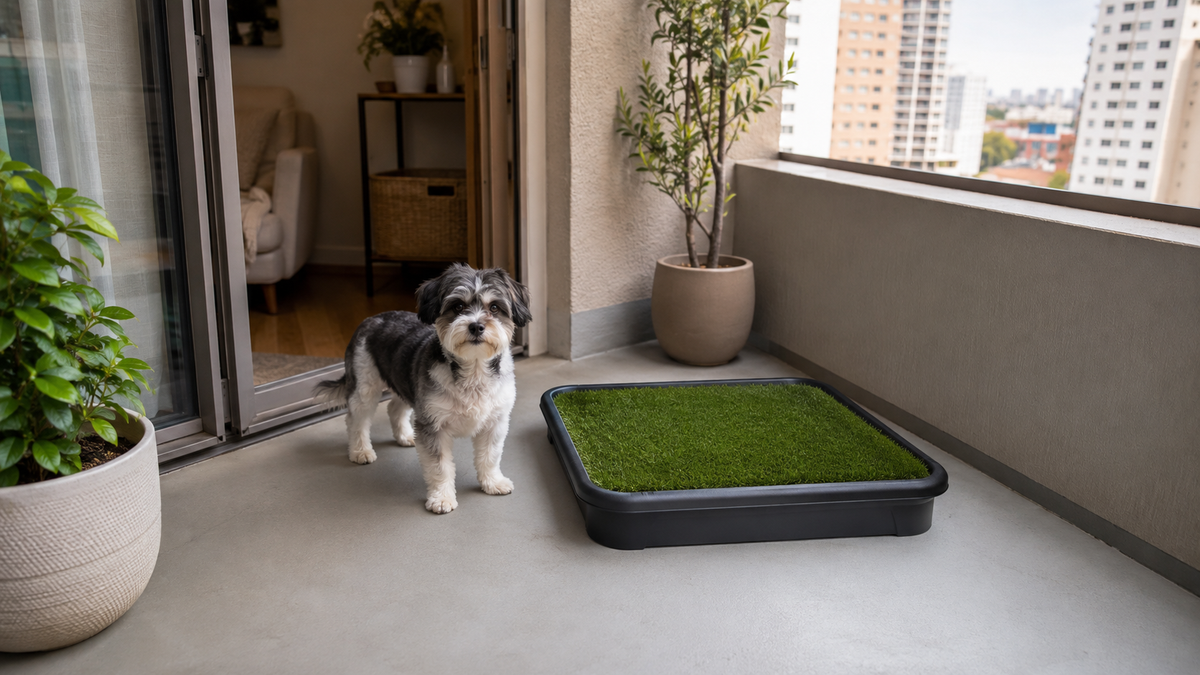
Every guide to balcony dog grass is written by someone selling the grass, and all of them forget the one thing that decides whether it works: it is a balcony, on top of somebody else's balcony. Before comparing real grass against artificial, answer three questions. Where does the liquid actually go? Does your lease or the building's rules govern what sits on the balcony and what drains off it? And how heavy is the tray when it is wet, on a high floor, in wind? Those three decide the purchase. The surface is a detail by comparison.
Where the drainage actually goes
Product descriptions for these systems commonly describe a quick-draining base with a hose that routes runoff "to a designated area". That phrasing assumes a garden.
On a stacked balcony there is no designated area. There is the balcony below, or a communal walkway, or a drain that was designed for rainwater and is shared. Routing dog urine into any of those is, at minimum, a neighbour problem, and quite plausibly a breach of building rules.
So the workable version in an apartment is almost always a closed system: a tray or catch basin that collects everything, which you empty and rinse into your own toilet or sink. That changes the shopping criteria completely. You are not looking for the best drainage; you are looking for a container you can lift, carry through your flat without spilling, and empty without disgusting yourself.
Ask that question of any system before anything else: when it is full, what do I physically do with it?
What your lease and house rules say about the balcony
Balconies are among the most regulated parts of a rented apartment, because they are visible and because what happens on them lands on other people.
Three things to check before buying:
Whether anything may be placed on the balcony at all, and whether there are appearance rules. Many buildings restrict what can be visible from outside.
Whether liquids may be discharged from it. Some house rules address this explicitly, usually because of a previous incident.
Whether it counts as an alteration. A freestanding tray almost certainly does not, and anything fixed to the railing or the wall very likely does: what counts as a "modification" you need permission for.
Where the rules live, and how they can change without your lease being reissued, is in building amenity rules: dog runs, elevators and lobbies.
Weight, wind and a high floor
Two practical constraints that vendor pages never raise.
Weight. A tray of saturated substrate is much heavier than the dry product, and you have to carry it through your home to empty it. Try lifting the empty unit and imagine it holding several litres of liquid.
Wind. A lightweight pad on an exposed balcony several floors up is a projectile. Anything on a balcony needs to be heavy enough, or secured well enough, not to leave it, and "secured" runs straight back into the alterations question above.
Add cold, too. In a climate with freezing winters, a wet tray on a balcony is a solid tray on a balcony for part of the year, which is a scenario worth planning for rather than discovering.
The three surface families and what each trades
No product recommendations here. This site publishes no picks while it has no affiliate disclosure page, and it has not tested any of these systems.
| Family | How it works | Trades |
|---|---|---|
| Real grass | Living grass with soil and roots, delivered and replaced periodically | Reported to encourage use through a natural surface, and the soil layer absorbs and dries which reduces pooling and odour. Recurring cost, and it dies |
| Artificial grass | Synthetic turf over a drainage layer and tray | Durable, urine-resistant, reusable, cuttable to fit. Depends entirely on a rinsing routine; neglected, it is the worst-smelling option |
| Disposable substrate | Bark, paper or similar in a tray, discarded and replaced | Simple, no rinsing, and the most ongoing waste and cost. Can track through the flat |
Reported general structure across systems: a surface, a drainage layer, and a tray that collects moisture and keeps the balcony clean. That third component is the one that determines whether the whole thing is tolerable in a small home.
Odour is a tray-and-rinse problem
Every product page implies the surface solves odour. It does not.
Liquid collects in the tray, and the tray is what smells. Real grass mitigates this by absorbing and drying in the soil layer; artificial grass mitigates nothing on its own and depends on you rinsing it on a schedule. In both cases the tray needs emptying and cleaning far more often than people expect when they buy.
Before committing, decide honestly whether you will rinse a tray several times a week, indefinitely. If the answer is no, an artificial system will become the thing you regret, and the small-space odour dynamics that make that unpleasant are covered in puppy pads in a small apartment.
What we have not tested, and what this page is therefore for
This site has not tested any of these systems, and does not publish product recommendations while it carries no affiliate disclosure. That limit is stated rather than disguised, because a page pretending to hands-on experience it does not have is worth less than an honest framework.
What this page offers is the set of constraints that a manufacturer's guide will not raise: the drainage destination, the building's rules, the weight, the wind, and the rinse routine. Work through those and the shortlist usually narrows to one or two options on its own.
It is also worth being clear that an indoor or balcony system is generally a supplement to outdoor trips rather than a replacement for them, and that it carries a habit trade-off. The routine it supplements is in the potty routine when there's no yard and an elevator in the way, and the wider picture is in keeping a dog well in an apartment.
FAQ
Can my dog use the balcony as a toilet? Sometimes, and the deciding factor is usually drainage rather than the dog. Liquid must be contained and emptied by you rather than routed off the balcony, and your building's rules may address both what sits on a balcony and what may be discharged from it.
Real grass or artificial grass for a balcony? Real grass is reported to encourage use and to absorb and dry, reducing odour, at a recurring cost. Artificial is durable and reusable and depends entirely on a rinsing routine. Choose by whether you will realistically maintain it.
Do these systems smell? The tray smells, not the surface. Odour is a function of how often you empty and rinse, which is the commitment to assess honestly before buying.
Do I need my landlord's permission? A freestanding tray usually is not an alteration, and anything fixed to a railing or wall very likely is. Balcony appearance and discharge rules are also common, so check the house rules before ordering.
Will an indoor option confuse house training? Prolonged indoor options are commonly reported to build an indoor association, which is a real trade-off. That is a training question rather than a hardware one, and it belongs with a qualified trainer or a veterinarian.