
Balcony Railing Gap Pet Safety: What Pets Slip Through
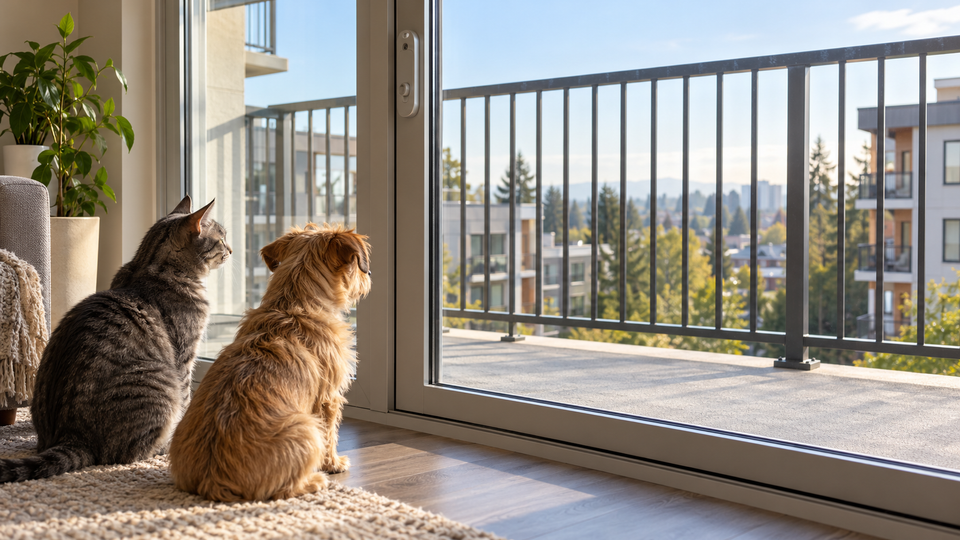
Balcony railing gap pet safety starts with a fact most renters never hear: the gaps in your railing were sized for people, not for a cat or a small dog. US building codes limit guard openings so a 4-inch sphere cannot pass. That rule says nothing about a flexible animal, and veterinarians say cats and dogs do squeeze through balcony railings. So a railing that passes inspection is not proof your pet is contained. Measure every gap, treat the whole railing as open, and do not leave a pet out there alone.
If your pet has already gone over or through a railing, do not wait to see how they seem. The ASPCA says a fallen cat should be "immediately located and taken to the nearest animal hospital or family veterinarian." Treat a fallen dog the same way. Call the emergency vet on the way. Everything below is prevention.
This is general safety information, not veterinary or legal advice. Your vet is the right person for your own animal's health, and your lease and building rules decide what you are allowed to attach to a balcony.
Balcony railing gap pet safety starts with what the code measures
The railing on your balcony is called a guard in building codes. In the International Building Code, the model code many US jurisdictions adopt with their own changes, section 1015.4 sets the opening rule. The 2021 edition as adopted in Illinois, which we read on UpCodes on September 25, 2026, says required guards "shall not have openings that allow passage of a sphere 4 inches (102 mm) in diameter from the walking surface to the required guard height."
Two details in that same section matter for pet owners:
- The rule loosens near the top. An exception allows openings that pass a 4 3/8 inch sphere between 36 and 42 inches above the walking surface. The upper part of a compliant guard can have slightly larger gaps than the lower part.
- "From the walking surface" means the bottom counts. On a railing built to this rule, the space between the floor and the bottom rail is held to the same 4-inch limit as the spaces between balusters.
Local versions differ, and older buildings were built to whatever code applied at the time. Treat these numbers as the general principle, not a statement about your own balcony.
Why a gap that passes code can still let a pet through
The sphere test is a pass or fail check with a rigid ball, written for human safety. An animal is not a rigid ball. A cat or a small dog can turn its head, flatten its shoulders and push.
Veterinarians are direct about this. In a PetMD article on balcony safety (published April 23, 2018, read September 25, 2026), Dr. Sonja Olson, a senior emergency clinician at BluePearl Veterinary Partners, says: "Cats and dogs can squeeze through balcony railings, but cats are more prone to jumping onto and over them." The same article lists "getting a head or limb caught in a railing" as a further risk.
The ASPCA makes the same point about child safety hardware at windows: "Do not rely on childproof window guards to protect your pets! Cats can slip through them." A gap sized with a child in mind is not a gap sized for a cat.
We looked for a veterinary body that publishes a safe gap width for cats or small dogs and did not find one. So this article will not give you a number that makes a railing "pet-safe." Anyone who quotes one should be able to tell you where it came from.
The five gaps to check on any rental balcony
Most people look only at the spaces between the vertical bars. Those are rarely the only openings. Walk the whole balcony and check each of these.
1. Between the balusters
Measure the clear space from the inside edge of one bar to the inside edge of the next, not center to center. Check several points along the run. Bars bend, welds fail and one wide gap is enough.
2. Under the bottom rail
Look where the railing meets the floor slab. On some balconies the bottom rail sits above a gap, and on others it has warped or the slab has settled. A small dog that cannot fit between the bars may still fit underneath.
3. At the ends, where the rail meets the wall
The last baluster often stops short of the building wall or the corner post. That end gap is easy to miss because it is usually behind a chair or a planter.
4. Around dividers between units
Many buildings separate neighboring balconies with a partition panel. Look at the space beside, under and above that panel. It may lead onto the next balcony rather than straight down, but a pet on a neighbor's balcony is still out of your reach and still on an open ledge.
5. The top rail itself
Dr. Olson's point is that cats tend to go over rather than through. A flat top rail is a walkway to a cat. The Vet Times reported on August 12, 2025 that Alexandra Dontu, head vet at Vets for Pets Sheffield Drakehouse, warned that "even small gaps or the thin ledge of a balcony railing can be dangerous." Furniture near the rail makes this worse; the PetMD article advises moving furniture away from balcony edges so animals cannot use it to jump over.
How to measure your railing without touching it
You do not need tools beyond a tape measure and your phone. Nothing here involves climbing, leaning over or loosening anything. If any part of the railing feels loose when you rest a hand on it, stop and report it rather than testing it further.
- Measure the clear gap between balusters at several points, top and bottom.
- Measure the height of the gap under the bottom rail at each end and in the middle.
- Measure the end gaps at the wall and around any divider panel.
- Photograph each measurement with the tape visible, and note the date.
- Write down anything loose, cracked, rusted through or missing.
Here is the useful part for a renter. If any opening on a guard is wider than the code limit that applies to your building, that is not a pet preference. It is a possible building safety defect that affects every person who uses the balcony, and it belongs in a written repair request to your landlord. Your dated photos are the record. If you want help framing that request, our guide on how to ask a landlord to install a pet device covers putting it in writing.
If every gap meets code, you have learned that the railing is built for people. You have not learned anything about your pet.
Cats and small dogs fail in different ways
The risk is not the same for every animal, so it helps to know which failure you are guarding against.
| Animal | Most likely way out | Where to look first |
|---|---|---|
| Cat | Up onto the top rail and over, per the BluePearl clinician quoted by PetMD | The top rail and any furniture or planter within jumping reach |
| Cat | Through a gap, especially when focused on something outside | Balusters, end gaps, divider gaps |
| Small dog | Through or under, at floor level | Under the bottom rail, low baluster gaps, end gaps |
| Either | Head or leg caught in a gap | Any gap near the animal's size, including ones it cannot pass through |
That last row matters. A gap too narrow for a pet to escape through can still trap a head or leg. A trapped animal on a balcony, possibly in the sun, is its own emergency.
For dogs, the balcony is often where the potty setup lives. If yours does, our piece on balcony dog potty systems and where the drainage goes is worth reading alongside this one, because anything placed against the railing can also act as a step.
What closing the gaps involves in a rental
People close railing gaps with mesh or netting tied along the railing, clear rigid panels, or a fully enclosed setup. We are not recommending a specific product here, for two reasons.
First, anything attached to a balcony railing is usually a question for your landlord, and sometimes for a condo association as well. Balcony railings are part of the building's exterior, and a lease clause about alterations may apply even to something held on with ties. Our explainer on what counts as a modification in a lease walks through how that language tends to be read. Get permission in writing before you install anything, and never drill into a railing, the slab or the facade.
Second, and more important, no barrier replaces supervision. Netting can loosen, ties can degrade in sun, and a panel only covers the gap it is fitted to. The PetMD article stresses "the importance of supervising your companion while on the balcony. It takes just one moment."
The honest limit: no gap is a "pet-safe" gap
Here is the plain version:
- The code gap limit is about people. It is not a pet standard.
- Veterinarians say cats and dogs can get through railings, and cats also go over them.
- No veterinary source we found gives a gap width that is safe for a cat or small dog.
- A barrier reduces risk while you are there. It does not make an unsupervised balcony safe.
So the practical answer is to measure, report anything that fails code, close gaps with landlord permission if you want to use the balcony together, and keep the balcony door shut whenever you are not out there with your pet.
FAQ
Can a cat fit through a 4-inch railing gap?
The 4-inch limit in the building code is built around a rigid sphere and human safety, not cats. A BluePearl emergency clinician quoted by PetMD says cats and dogs can squeeze through balcony railings, and the ASPCA warns that cats can slip through childproof window guards. Do not treat a code-compliant gap as cat-proof.
What is the code for balcony railing gaps in the US?
Many jurisdictions adopt the International Building Code, whose section 1015.4 says required guards must not have openings that pass a 4-inch sphere from the walking surface up to the required guard height, with a 4 3/8 inch allowance between 36 and 42 inches. Your local version and your building's age can change what applies.
Is my landlord responsible if the railing gaps are too wide?
If a gap exceeds the code limit for your building, it may be a safety defect that affects people, not only pets, and it is reasonable to report it in writing with dated photos. Whether and how your landlord must fix it depends on your lease and local law.
Are small dogs or cats more at risk on a balcony?
They fail differently. Cats are more prone to jumping onto and over railings, according to the BluePearl clinician quoted by PetMD, while small dogs are more likely to squeeze through or under at floor level. Either can get a head or leg caught.
Does balcony netting make it safe to leave a pet outside alone?
No. Netting and panels can reduce risk while you are present, but they can loosen or degrade, and no barrier replaces supervision. Keep the balcony door closed whenever you are not out there with your pet.
Comments ()